Object of the Month: October 2026
Share
The Daisy Wheel Chest: Witch Marks and Wards
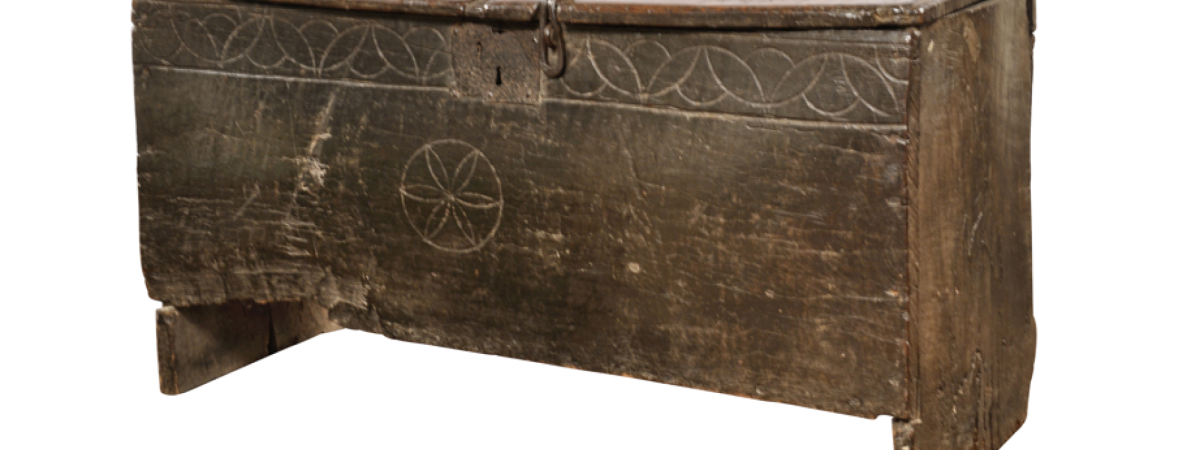
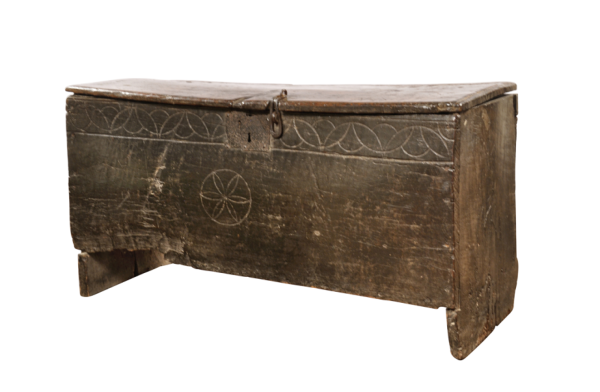
The object I have chosen is a simple, rather unassuming 17th century chest found in the upstairs bedroom. This battered and crudely put together chest has been through a lot in its lifetime, having had parts removed to act as a radiator cover in the early 20th century. It is not the construction of this object, or the lovely carved border along the front panel that caught my eye with this object, but the huge witch mark scored in just below the lock.
The chest itself is thought to date from the 1630s, a period in both England and mainland Europe when anxiety about witchcraft and spiritual evil was at an all-time high. Witch marks – also called apotropaic marks if we’re being fancy – were added as protective measures against evil spirits and bad spells cast by witches (maleficium). Adding witch marks to potential points of entry in your house, such as doorways, over windows and by chimneys was just as logical a part of protecting your house as locking doors and windows with a physical key.
Furniture could also have witch marks carved into them, usually beds, chests and cupboards. Your bed is where you are most vulnerable, since it’s where you sleep, and chests and cupboards contained items that were expensive, sentimental or otherwise important things you’d want to keep safe.
The Daisy Chest is so called for the daisy wheel (or hexafoil) on the front, its intersecting circles creating a never-ending line in which the spirit becomes trapped. Other popular forms of witch marks include a pentagram, originally representing the five wounds of Christ; Marian Marks, two intersecting Vs, representing Mary, virgin of virgins, and burn marks purposely placed on wooden beams.
What makes the daisy wheel on this chest likely to be an apotropaic mark, and not simply decoration or even a carpenters’ mark, is the context in which it is placed. As I mentioned, witch marks in a house are placed at weak spots in its construction where something evil could get in. Witch marks on furniture follow this same logic – a key-hole would be the perfect place for an imp or spirit to slip in unnoticed. The proximity of the daisy wheel to the key-hole suggests a spiritual lock as well as a physical one to keep the contents safe.
The most exciting questions surrounding this object are of course the ones we shall never be able to answer: who owned this chest? And what was inside that they wanted so badly to protect?
Written by Julia Hull, Volunteer
Edited by Niamh Reid, Museum Assistant