Object of the Month: September 2026
Share
Before we take a look at our esteemed objects for this month, it must be said that there is a cause to celebrate! That cause being that the Object of the Month blog has officially been running for one whole year without a missed post. This time last year, I embarked on the mission to attempt to revive our Object of the Month blog which had been left dormant and sporadic for some time, as it is not necessarily one of the priorities of the busy nature of running a museum that the already hard-working team have here. With the help of Megan, who has since moved over to The Coffin Works full-time (another wonderful museum full of similarly amazing staff and volunteers), we managed to get the collection blog segment off the ground once more! Since, we have looked at many ordinary objects with hidden stories to tell, considered mistaken item identities, and opened up more opportunities to other volunteers. For example, last month’s fantastic August blog was written by Toby, who I think everyone will agree is a highly dedicated member of the volunteering family. As we hopefully look to another year of Object of the Month, I am excited to explore more deeply the importance of Laurence Cadbury’s work and passions in putting together the collection of the museum, how the objects reflect on daily life of their respective periods, and more collaboration with the people behind Selly Manor Museum, including Niamh, who has been, and will be assisting to take care of these blogs from now on.
Now, to begin, for our object of the month blog this September, we are looking not at just one object, but two! This is because my research mission for this time around was to get to the bottom of the question 'what is the oldest object in the collection?'. The answer comes down to two different pieces with the same time period estimation of 1500-1550.
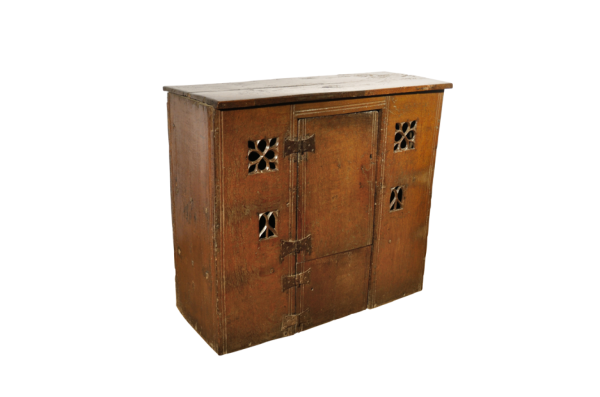
The Dole Cupboard at Selly Manor Museum
The first item is our dole cupboard, which is located in the parlour of Selly Manor. This is perhaps one of our favourite and most iconic pieces of furniture, not only due to its age, but due to its social significance and associated stories. It is a medium-sized oak cupboard with a central door, and four carved windows that allow air circulation for the food inside. It may sound counterintuitive today, but ventilation was key to preventing the spoiling of food for centuries before refrigeration was prevalent. These cupboards were typically kept in churches or gatehouses and were sometimes called 'livery cupboards', as the food within would have been collected from leftover meals and then doled out to the poor or other members within the household. The name ‘dole cupboard’ is not a contemporary term of the period. Instead, we think the cupboards were often called ‘almerys’ or ‘aumbrys’ as they were overseen by almoners. To have leftover food in the late 15th and 16th centuries was a sign of wealth, and used as a way to keep the social order of the wealthy and the needy dichotomised.
The cupboard itself has likely been modified since it was manufactured. The hinges, along with the top and back panels, seem to have been replaced, along with a couple of other repairs to the panelling. Oliver Baker dated and valued the piece for Laurence Cadbury at the year or decade 1490, which is quite phenomenal for a piece of this kind, as not many English food cupboards of this period survive today. It is supposed that the nails inside the doors were to assist the hanging of a haircloth in order to prevent pests from entering the cupboard, and that this cupboard in particular may have previously had legs to keep it off the floor for the same purpose.
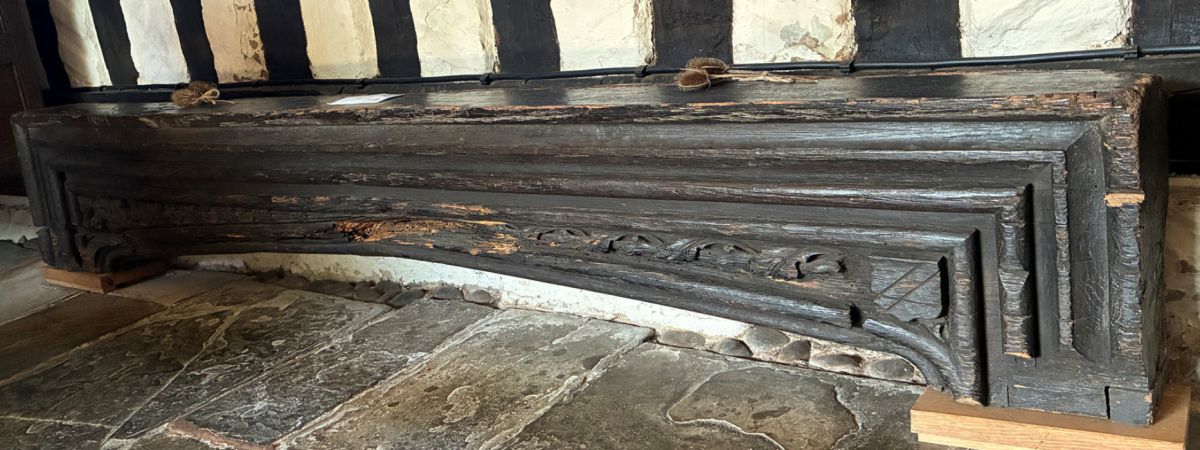
The second object that shares this time period, is an oak mantel beam which is resting on the floor against the wall in the dining room. Its appearance is deceiving and unassuming, but don’t be fooled! This is an authentic example of a carved Tudor fireplace shelf, and quite a long one in particular. On the left side, you can see the form of a Tudor rose, and on the right the form of a shield. Unfortunately, the piece is in quite poor condition, with evidence of rotting, chipping, and other deterioration – but considering that it is likely over 500 years old, it is still in quite good shape! We have many fireplace related objects in our collection from the early modern period, which is quite handy as there is a fireplace in almost every room! If anything, this is a clear way of helping us to understand the importance of fire for sustaining life in a world before gas and electricity became utilised.
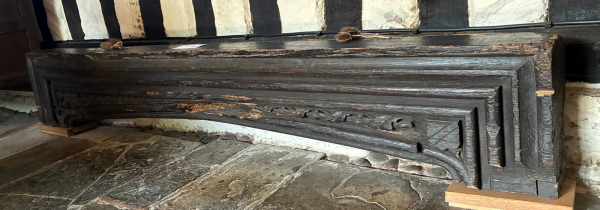
The Oak Mantel Beam at Selly Manor Museum
As we come to the end of the blog, I would like to thank all of our readers over the past year for keeping an interest in our collection, as well as everyone in the team at Selly Manor for assisting to keep my own curiosities kindled!
Written by Tristram Flood, Volunteer
Edited by Niamh Reid, Museum Assistant