In Conversation with Local Artists: Paul Lemmon
Share
For our new series on the Selly Manor museum blog, we will be interviewing artists from Bournville and the surrounding areas, to discover what inspires them, explore their creative processes, hear their thoughts on Bournville and its community, and also about their upcoming projects and exhibitions. Local artists are key to keeping our community a vibrant and dynamic place to live; through this series, we’re shining a spotlight on artists who live in, work in, or draw inspiration from Bournville, Birmingham and the surrounding areas.
Our first interview is with local artist and designer Paul Lemmon, who explores how humanity and technology interact through his paintings.
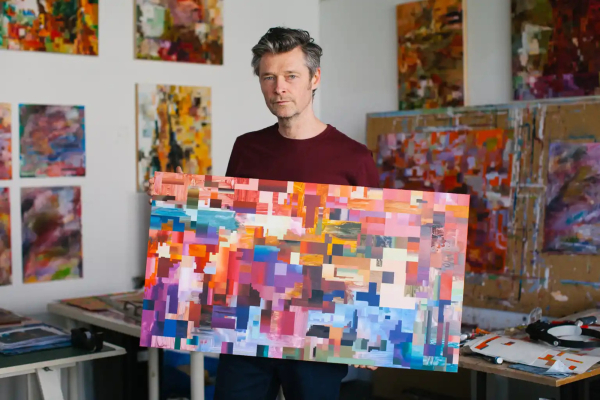
Paul Lemmon photographed by Paul Daly
Q1: Could you tell us a little about yourself and your work as an artist?
“As an artist I venture into cyberspace and collect material to bring back and transform into physical objects - oil paintings.
My paintings are based on downloaded digital video files which I’ve corrupted and broken up to create colourful fragmented compositions that I make into abstract and figurative paintings.
I was born and brought up during the early part of my life in and around Birmingham, then earned a degree in Graphic Design in London, where I lived and worked as both designer and artist for 30 years. After a spell in Folkestone and I returned to the Midlands and am currently based in Coventry working with art organisations in the Midlands.
I’m very interested in this current wrestle between technology and humanity, the real and the artificial. An oil painting is such a simple, defined thing, but it really symbolises the difference between a screen existence and the real world. It’s a portal into the mind of another person - an artist. Much like a song or a book. Those things can be digitised more easily, whereas a painting has to be physical by its very nature, so it’s quite a unique object to be making right now.”
Q2: How does Bournville (and/or the surrounding areas) inspire your work?
“I think the relationship between Bournville and the city is a reflection of what I’m trying to address in my work. The city itself is, broadly speaking, like the technological environment of cyberspace: manufactured, steel and glass, fast-moving and machine-like (albeit alongside older, historical buildings), whereas places like Bournville that are greener, cleaner, more serene, epitomise the human, more natural, breathable parts of existence. These are the two intertwined strands in my work, which compete and entangle. The textural, painterly areas and the geometric, ‘digital’ passages referencing the broken patterns of glitched videos that form a kind of landscape. Strangely enough, my journeys into cyberspace often feel a little like commuting into the city for work - though without the drudgery perhaps!
I find the origin of Bournville very inspiring from a kind of spiritual, social point of view. The way that it was set up by the Cadbury family of Quakers for their employees at the chocolate works is in a way a very artistic, creative ethos - humane and pursued in acknowledgement of the need for quality of life alongside work and commerce. This is what all artists are seeking in their practices really!”
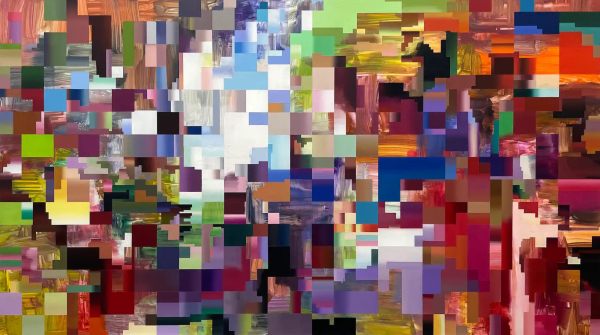
‘A stillness that moves’ by Paul Lemmon
Q3: Bournville is surrounded by both green spaces and city scape – how do each of these influence your work?
“As I said in my previous answer, the juxtaposition, or integration of cityscape and green space is analogous to the dynamics at play in my paintings. I often say that my intention for the viewer of one of my works is to experience something similar to a walk in nature as opposed to time spent on a screen (steel and glass) - the sheer physical presence of a painting, its invitation to stop, to linger, to become absorbed by the image, with no distractions. I think that idea really resonates with the Cadbury’s original vision for a healthy working and living environment for their workers, that business and production doesn’t have to be the sole motivation. It’s about living life for the sake of being alive, taking time to focus on the moment. Making art totally requires a person to enter into a singular focus, and that can be transmitted to the viewer by the final result when they look at it.”
Q4: Is there a particular piece of local history or heritage that you find yourself drawn to? Why do you think this is?
“In terms of what I’m drawn to in the area, I immediately think: Chocolate! I have a slightly magical image of the area because of its history and creation. Cadbury’s and the Bournville product itself exists vividly in my mind from childhood - the drinking chocolate, the Bournville dark chocolate bars that my mum likes. I remember an old Bournville cocoa tin my nan had, with the rich red and gold colour, line illustration and lettering. It conjured an enchanted place in my mind, a Willy Wonka fantasy miles away from the concrete maze of the city. I suppose this was something that the chocolate manufacture wanted to bring into reality with Bournville village. I’m not a big fan of nostalgia, but the name Bournville evokes these memories and feelings instantly.
I know that the development of chocolate - cocoa and sugar - have a very problematic history, but I’m glad that the original Cadbury family played a strong part in addressing and remedying that. If only more firms across the world in the present day would and take a lesson from their vision for the well-being of their workers and environment.”
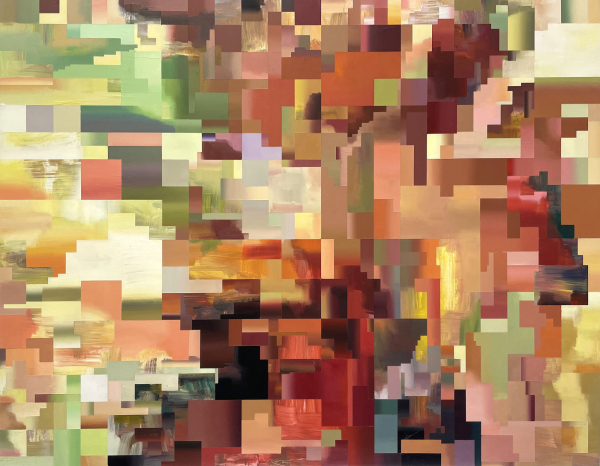
‘The sand that makes the glass’ by Paul Lemmon
Q5: Why do you think art is important to the local community?
“I think communities everywhere need space and freedom from the pressures of modern life. Art can represent some of that freedom I think. It’s easy to be held in a mindset that everything should be for a function; commercial concerns, work and making a living can program us into a way of living which is always goal and purpose orientated. The beautiful thing about art is it essentially has no purpose, it just IS! Yes, it can decorate, yes it can communicate and inspire. But it’s existence is really a profound thing and the reason it’s sometimes dismissed is that it can seem to be kind of useless! But in making art and looking at it I think people can discover a vital meaning of life - we are human ‘beings’ not human ‘doings’. Art can remind us of that because it just exists for its own sake. A bit like chocolate - its a sensual pleasure, and we can enjoy it just as a matter of being human.
It can also bring people together of course, which communities desperately need - I think areas like Bournville, Stirchley and Kings Heath have that culture happening and it’s making a difference.”
Q6: How do you feel your art connects with the people of Bournville/Birmingham? Or how do the people of Bournville/Birmingham connect with your work?
“Though my art isn’t connected specifically with the people of Birmingham or Bournville, I think many people know of my work there now, so they can enjoy it and connect with it just from a place of being art lovers, perhaps. Though I would hope that maybe they would glean the juxtaposition of cityscape and green space somewhere in the spectrum of colours and shapes happening in the compositions. I am represented by a gallery in the city centre though, Forward Gallery (Artists | Birmingham Art Gallery - Forward Gallery ), on Cannon Street, so that is a place where anyone can go and see my paintings in real life.”
Q7: Do you have a favourite artwork that you’ve created that you could talk us through?
“One of my favourites, or most significant for me, is the commission I created for Coventry Biennial in 2023 which addressed the possibility of energy transition for the City of Coventry and ending climate change. Made in collaboration with a Professor of Literature at University of Warwick, it was probably the most challenging artwork I’ve ever undertaken and really stretched my creative muscles and helped me evolve as an artist.
The final piece was a 6 meter long painting accompanied by a text panel running in sync with the painting. The Professor, Graeme Macdonald, specialises in science-fiction literature and environmental studies, so we created a timeline stretching to a hundred years into the future from the beginning of fossil-fuel production in Coventry, and the painting followed the twists and turns of how this evolution went. The timeline is positive story with the intention of inspiring the minds of Coventry residents about what might be possible for the city. It was displayed in The Herbert Art Gallery & Museum during the Biennial run.
You can read all about it on my website here: Paul Lemmon artist painter ”
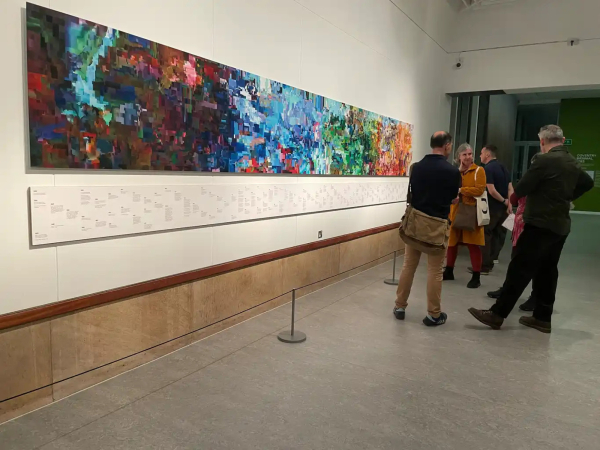
Paul’s work for the Coventry Biennial (2023)
Q8: What is next for you – do you have any upcoming projects or exhibitions that you’re excited about?
“September is looking like it’ll be a busy month for me as I have a few exhibitions coming up. I’ll be part of group show of 10 artists at The Courtyard Gallery at The Core in Solihull beginning at the end of September, called ‘Vista’, looking at Midlands artists dealing with landscapes from a new, modern perspective. It’s organised and curated by Ruth Millington and will be a really exciting, worthwhile show, more details here:
I’ll also be part of another exhibition at the Midlands Art Centre around the same time, ‘Surreal Solihull’, which will show alongside presentation of the Surrealist Emmy Bridgwater, so it’s quite privilege to be part of that.
https://macbirmingham.co.uk/exhibitions/surreal-solihull
In addition to that, I’m moving into a new art studio in Coventry at the canal basin, which I’m really looking forward to. That is it’s own historical heritage site and will be really interesting to be making art in the old storehouses of the Midland canal network in Coventry.”
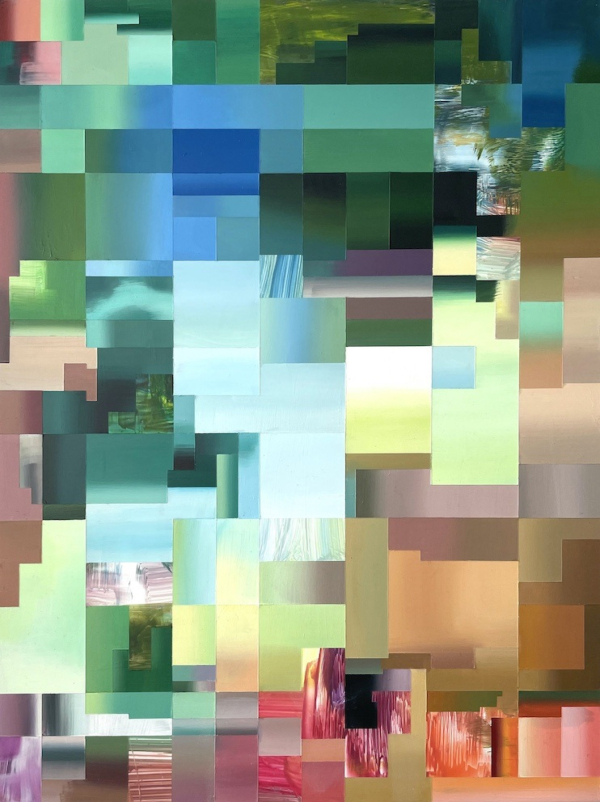
‘Hanging green’ by Paul Lemmon
A big thank you to Paul for sharing his time, creativity and insights with us. To find out more about Paul and view more of his artwork, his website can be found here: paul lemmon home and his Instagram username is @paullemmon_art
Written by Niamh Reid, Museums Assistant