Object of the Month: April 2026
Share
Romayne Panel
This is an object in our collection that has a sense of mystery. Don’t be fooled by its simple appearance and reserved location on the stairwell - researching it has been a challenge.
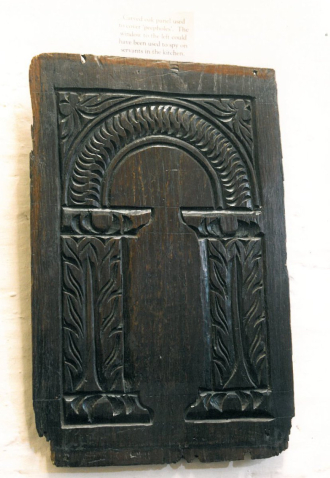
Image above: This decorate panel can be found on the staircase from the Dining Hall to the Bedchamber.
In our object files, this carved wooden oak piece is described as a peephole cover. There is no further information about when it was made, how it came into the collection, or even just its measurements. I spent hours trying to explore the development of peephole covers through the centuries, but to no avail. I couldn’t find anything that even vaguely resembled the object that we have at Selly Manor Museum by using this descriptor. It has been suggested that it might have just been a piece of decorative wood panelling that has been pulled off a piece of furniture, but this didn’t satisfy me. The back of the panel and the surrounding edges seemed too smooth and properly formed to resemble something that had been roughly salvaged from a larger object.
Eventually, I suspected that I had found the answer. It appears to be a romayne panel. Romayne panels were mainly popular through the 16th to 17th centuries, and acted as French-influenced decorative pieces that hung amongst the wooden interior walls of more important rooms. More often than not, they feature two opposing heads within roundels (one being a man, the other a woman) that ‘look’ towards each other, although there are many examples of simpler pieces that may have accompanied them. The V&A have a detailed Romayne panel in their catalogue, which shows the common features: Cupboard Door | Unknown | V&A Explore The Collections
Romayne work could also be found on the front surfaces of furniture, like cupboards for example, and doors. Similarly to many household items in the early modern period, there was a further sense of functionality that accompanied these wooden pieces, in that they helped to reduce drafts through houses and keep rooms better insulated.
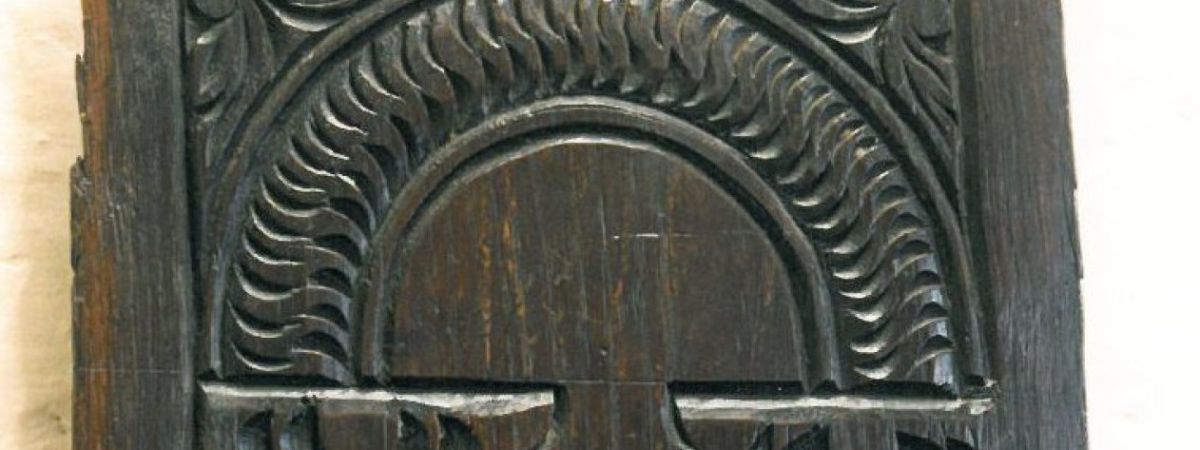
Our panel features an arch and some further decoration in relief. Its purpose may have been to hold place as one of the aforementioned simpler panels, or possibly it could have been from a household with a lower income, or less access to more skilled and extensive work. When we look at decorative arts, the less flashy pieces often go understated, so hypothetically it would make sense that examples like the one we have would retain much less interest through time. It’s difficult to say when the object itself was actually made - there is the possibility that it could be a later imitation. There is the further mystery of why it was deemed a peephole cover in the first place, is there still a chance that this was really its primary function?
Written by Tristram Flood, Volunteer
Edited by Megan Ward, Museum Assistant