Object of the Month: February 2026
Share
Our object of the month for February doesn’t have a monthly theme as many of my previous ones have, as this time I wanted to take a different approach to selecting an item to research and write about. I decided to simply go through the museum and pick an object that caught my eye, one that seemed like it could have a story to tell.
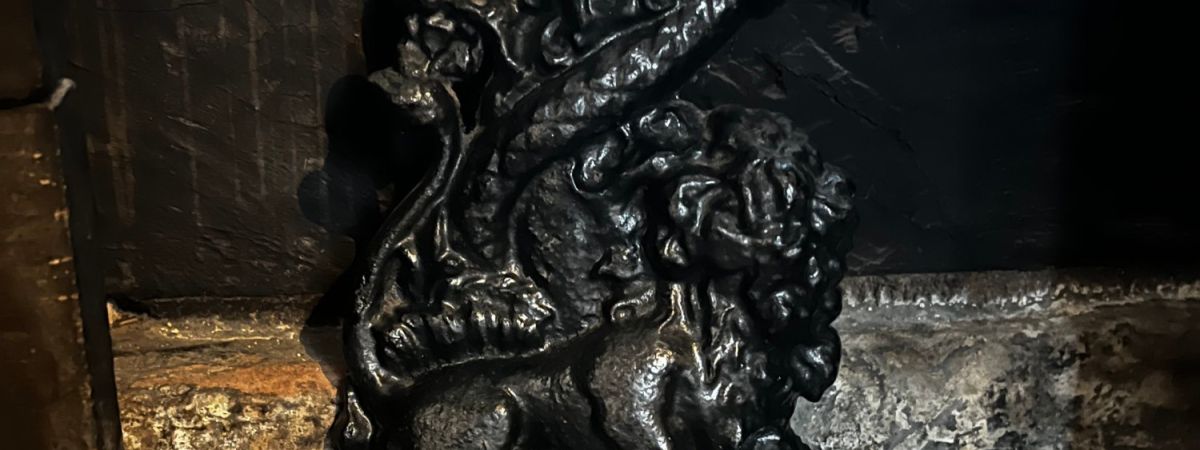
What did catch my eye, while just about to walk into the kitchen, was a small black door porter resting on the floor – not actually holding anything open. I was intrigued, first of all, by what the design actually was. As it is hidden in a fairly dark corner, and the glare of the black casting obscures much of the fine detail, it initially required a little bit of squinting and head tilting. After a fair many seconds, I realised that it was a lion and a snake.
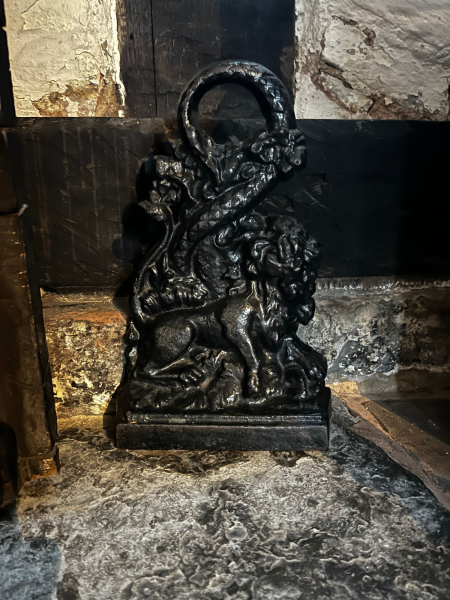
Image above: The Door Porter is located in our dining hall in Selly Manor Museum.
Lions and snakes are often associated with each other in symbolistic art and design, commonly through the 19th century in particular. Most notably these two animals have significant biblical references, the serpent in Eden connotes sin and cunning, and many stories elsewhere feature lions or mention lions, such as Daniel in the lion’s den. There is also the use of the lion as a major heraldic symbol in Britain. The Victorian zeitgeist also adopted much Ancient Greek influence in literature. In a collection of Aesop’s fables attributed to a man named Joseph Benjamin Rundell (many fables said to be written by Aesop were in fact not), there is a fable of a lion and a snake. The lion is proud and haughty, and kicks aside a snake who is lying on the floor besides him. The snake then recoils and attacks in turn, proving that despite his small size and insignificance, he can still stand up to creatures of much larger stature.
This cast iron door porter is likely from the earlier Victorian period. There was no information in our object history files, so all research I had do from scratch. I found many examples of this piece that have been on sale at antiques auctions in the past, which signifies that it was likely mass produced. What also indicated this, is that there is no hallmark or date present anywhere on the body. The details are also difficult to make out, and although this could be attributed to regular deterioration, it seems like it hasn’t been produced with as much care as more archetypal examples of great Victorian manufacturing.
One of my favourite features of this object is that the snake also acts as a handle. This is what distinguishes it from being classed as a door stop, as door porters feature handles to allow them to be picked up and moved about quickly and easily (despite the fact that these weighs approximately 4 kilograms, although you have to remember doors often used to be heavier). They would more often be used briefly or temporarily, rather than as permanent fixtures of a home.
Written by Tristram Flood, Volunteer
Edited by Megan Ward, Museum Assistant