Object of the Month: January 2026
Share
The tradition of the New Year’s Day gift - Pewter Plate
Historically, the New Year was actually celebrated on 25th March until 1752, when the Gregorian calendar replaced the Julian one. Despite this, gifts were still given on the 1st of January to follow the Roman tradition and the celebration of Janus. In Tudor and Stuart courts, there was a strong custom of gift giving within royal circles on the first of January every year. Arguably, the courts relied on traditions and customs such as this in order to uphold the structure of hierarchy, and to allow courtiers opportunities to traverse the complex relationships surrounding the nobility. On the other hand, it also allowed those with more power (such as the King or Queen) to give to their subjects in turn, in order to display favour (or disfavour) and ultimately emphasise their political control.
The Master of the Jewel House (or Jewel Office) and his assistants would record every gift received from or given to the monarch on a large scroll of paper called a ‘gift-roll’. All participating courtiers were organised in the list by descending rank, and if you had fallen out of favour you were not allowed to participate at all. An element which I find amusing is that, although a member of the royal court may gift a present (or presents) of a unique and highly valuable calibre, in return they often simply received a gilt plate.
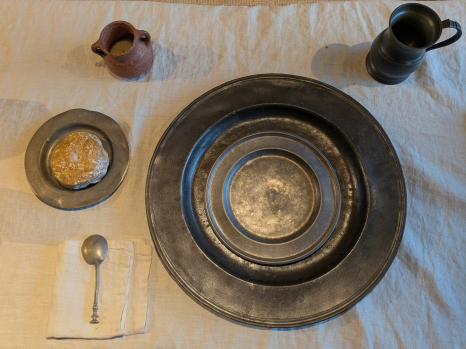
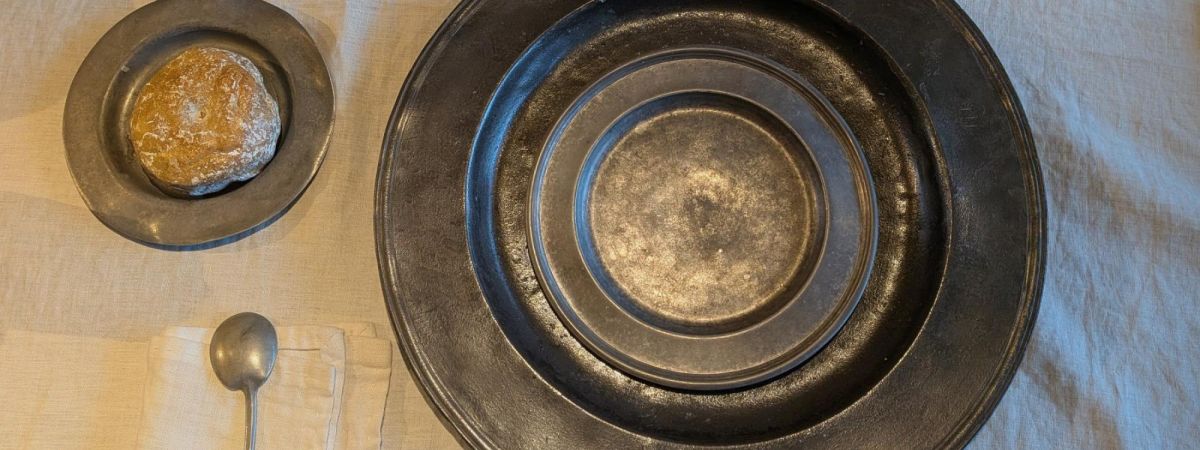
Image Above: Pewter Charger Plate laid out on the dining table at Selly Manor Museum.
The object I have chosen for this month is one of our simple pewter plates. We unfortunately do not have any gilt plates like the kinds that lords may have received from Henry VIII or Elizabeth I, or from later Stuart monarchs, but in my opinion this difference serves well in accentuating the dichotomy between people of higher and ordinary social status. Although today Selly Manor stands out as a unique and beautiful building in the midst of Bournville, these connotations would have been less relevant during the periods when it was actively lived in. It was an ordinary home, or sometimes a set of homes, of much less note.
This plate specifically is an 18” single-reeded charger plate, without any further decoration, dating from around 1690. A charger plate is used as a decorative base placed underneath the dinner plate which would be eaten from. It is common now for charger plates to be a maximum of 14”, which is interesting when considering how dinner service and etiquette have changed. Pewter dishes were sometimes collectively known as sadware, and apparently nowadays the term ‘charger’ is even considered outdated among pewterers. From the period around 1650–1780, which this plate belongs to, pewter dishes were mass produced and widely sought after by families across Britain, as the early modern era progressed and people became increasingly concerned with material possessions.
So, although I am sure the plates given out by the royals for the (Roman) New Year were much more exciting, ours do still have historical character of their own!
Written by Tris Flood, Volunteer
Edited by Megan Ward, Museum Assistant