Object of the Month December 2025
Share
Object of the Month December 2025
Dining Room Long Table
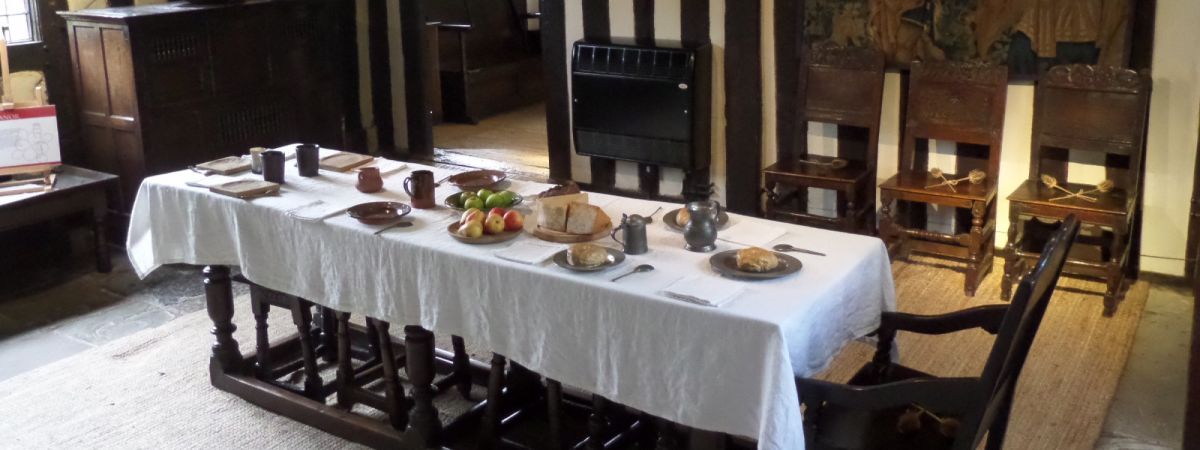
Image above: Our Long Table in our Dining room dressed in the Tudor style.
Winter is officially here, it seems to have come around quicker than ever this year, and what better way to end 2025 than with a blog about a table?
As Christmas approaches, one image that often comes to mind is families and friends gathering, sitting together around a large table sharing food and conversation in the spirit of the season.
Selly Manor is full of wooden furniture, some of which are more eye-catching than others thanks to their detailed hand-carved decorations, but the object I have chosen to write about this month hardly draws much attention – at least at first glance. So why have I chosen this? Well, I wanted to focus on something plain but with a lot of functional detail: an object with its very own historical evolution. Part of my enthusiasm behind these blogs is being able to look at pieces that hardly garner praise and interest, but which nevertheless speak volumes about how people lived in the past. This table can tell us not only about the people, but the building too, and how it has changed.
Firstly, it is important to note that the definition of ‘table’ that we understand today is relatively modern. Historically, the word ‘table’ was used to describe a multitude of different objects, such as pictures and frames, other furniture, and a lot of other things with a rectangular shape such as chess boards. We can still see traces of this boarder meaning today, for example, the origin of ‘times tables’ in mathematics. The concept of table that we are familiar with derives from ‘table board’, which specifies the flat top that sits on top of the underframing.
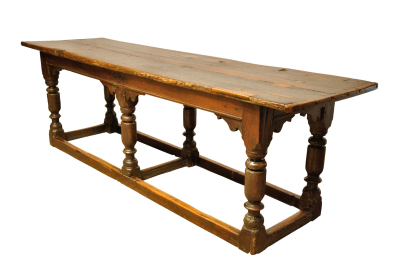
Image above: This image shows the modest detailing on the frame.
The whole table in the dining room of Selly Manor Museum, is a mid-17th century oak long table, likely dating from the 1640s, and it measures over 8ft in length. It originates from Claverdon in Warwickshire. It features a removable table board, six legs with spandrels, and a plainly moulded frame. Now the table is used as a centerpiece in the middle of the room, but the elements of its carvings suggest a different original position and function within a home. In the medieval era, side tables were favoured due to the historic dining practice where people used to sit at the table with their backs against the wall to allow easy serving. As such side tables generally only have detail on one side. Notably, our long table only has moulding on one side, with one side being entirely flat and plain, and the other three having a kind of basic channel through them. This strongly suggests that our table was originally a side table placed against a wall.
Practically, the reason why the table board is removable, and why tables weren’t joined for a very long time, is for two main reasons. Firstly, one side would be clean and used for dinning, while the another would be used for tasks like preparing food and being rougher. Secondly, this allowed for disassembly, making the table easier to move and make space for events or other living arrangements.
Dining rooms themselves only started to come into fashion around the Stuart era, with privacy and comfort becoming more and more prioritised. Before that, and in the original Tudor manifestation of Selly Manor, you would often have larger halls for multiple uses, within which the practical design of the removable table board made the most sense.
This modest table offers a quiet reminder of how furniture has always shaped moments of togetherness, especially at this time of year.
Written by Tris, Volunteer
Edited by Megan, Museum Assistant