Object of the Month November 2025
Share
Object of the Month November 2025
Tankard
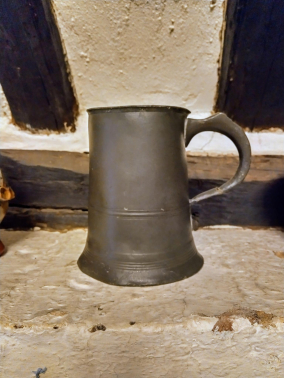
Image Above: This is a pewter tankard in our collection at Selly Manor Museum.
November’s object is coming in slightly later this month but nonetheless picks up on various interesting threads of one of the most prevalent features of this time of year – drinking.
If you have been keeping up with Birmingham’s news this year, you may know that the German Christmas market was put up reportedly on the earliest day yet, on the very first of November. Although beer and wine aren’t all the market has to offer, there is without a doubt a strong association with drinking alcoholic beverages and holiday festivities, and it is certainly noticeable before we enter the proper festive season!
Despite the fact that in Britain we don’t widely celebrate any specific holidays or celebrations in November, it wasn’t always the case. In fact, celebrating Christmas this early would likely have seemed very disrespectful to people in the Tudor era, as they had other religious days to celebrate. I previously wrote a blog for September speaking of Michaelmas, a celebration of St Michael. There are other saints through November who were celebrated similarly, such as St Martin, St Clement, and St Catherine.
However, after the English Reformation attitudes towards saints shifted and were respected with the same enthusiasm as they had been through previous decades. There were certain worries around idolatry and frivolous immorality that came with the celebration of some festivals.
In 1541, Henry VIII attempted to squash some of these activities – ‘catterning’, or ‘catherning’. The aforementioned days of St Clement and Catherine fall on the 23rd and 25th of November and involved a tradition whereby people went around begging and singing for apples and beer. Children were then reportedly banned from doing this in the respective Saints’ churches in London.
Alcohol played an important role in the diet of many, young and old, within the Tudor period. It is well known that water was less safe to drink than ales and beers, which people consequently relied on for hydration as they could preserve much better, especially beer. However, begging for alcohol on a holy day may have been a bit too far in the eyes of the Church!
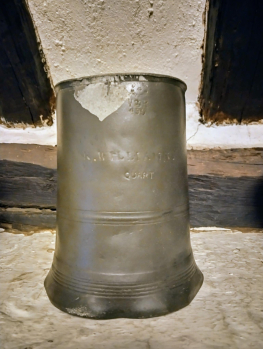
Image Above: The tankard shows the royal insignia of Queen Victoria near the top.
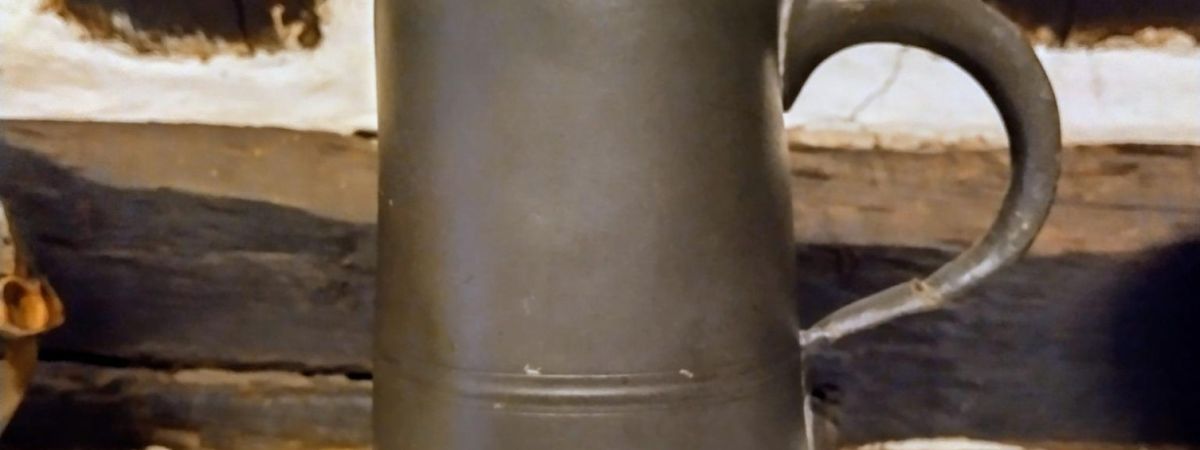
The tankard we have here at Selly Manor is actually not from the Tudor period. It is a pewter tavern tankard from Bristol in the 19th century. Something which I personally love about the collection of the house is that it is far more historically eclectic than the average visitor will probably notice. Laurence Cadbury, who is arguably the key figure in setting up the museum, had a great passion for antiques collecting, and derived the collection of the house from a wide range of centuries, but with a focus mainly on the 16th-18th. This breadth allows us to explore how everyday life has evolved. In turn, the collection offers a great way to truly see how ordinary life looked through time, and how really, many things remain the same.
Whether you’re a begging child in London, a tavern patron in the Victorian era, or an early bird in Birmingham’s German market today, it’s undeniable that drinking has a lasting connection with lifting spirits in the festive season. Perhaps a little ironic for us here, in consideration of Bournville’s Quaker ethos and roots.
Written by Tris Flood, Volunteer
Edited by Megan Ward, Museum Assistant (Massive thank you to our volunteer for creating so many brilliant blogs recently!)